“Carnival is a feeling”
November 9, 2007
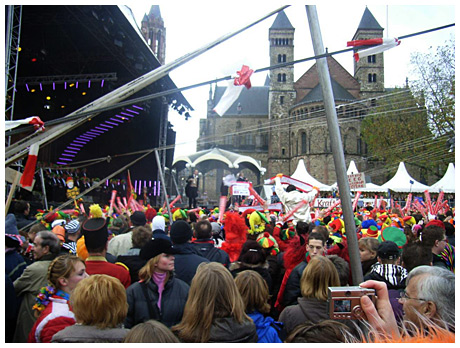
Very soon you will understand the special meaning of the number eleven in Maastricht and all the joyous madness and silliness that go with it. Like every year, the Mastreechter Staar choir will on the 11th of the 11th (11 November) open the carnival season, also known as the fifth season, and famous artists from the entire province of Limburg will perform on the Vrijthof square.
In truth, I have always associated carnival with a drinking feast and had assumed up until now that the Maastricht carnival was no different from the rowdy celebrations I witnessed in my home town in the Canary Islands: choosing a Prince, singing in the streets, getting dressed up and drinking abundantly. No real feeling behind it.
However the vivid testimonies of three passionate Maastricht carnival goers have finally helped me understand the true meaning of one of the city’s biggest annual event. As I listened to Leon Geurtjens and Leon Hensels, two former carnival Princes, and carnival enthusiast Marleen Vara, I knew I would now probably experience carnival in a complete new way.
Let’s forget about all our problems
Carnival is a big affair in Maastricht. Every neighbourhood has its own carnival association, which organises its own activities, elects its own Prince and chooses its own carnival song. One particular association however rules over the entire city. The Tempeleers (the “Templars”) choose the city’s carnival Prince and organise the official opening and closing ceremonies of the carnival season, the Drunken Band contest, the big carnival parades and many other activities.
Leon Geurtjens and Leon Hensels have celebrated carnival since their childhood. “My parents were members of the Keemeleers, the carnival association in Maastricht Wijck,” says Geurtjens, who was elected Maastricht’s carnival Prince in 2003. “I became involved with carnival through the Keemeleers and through the activities organised at school, like going to school all dressed up in carnival costumes on the Friday before carnival.”
“During the entire year we’re busy with work, meetings, family obligations, etc. but during carnival we can have fun in a very nice uncomplicated way and forget about all our problems, without any daily discipline,” Geurtjens explains. For both Geurtjens and Hensels, carnival is about having fun: getting out of bed, going into the streets, being yourself, having fun, even with people you’ve never met before, all of this in an unorganised way. “Thanks to the whole atmosphere, you can have fun even if you’re alone,” says Geurtjens. “Everyone is free,” adds Hensels, who plays in a carnival music band and served as carnival Prince for the nearby Maastricht´s neighbourhood of Itteren in 1994.
Enjoying the sounds of carnival
“But some people don’t understand the intention of carnival, or understand it incorrectly,” regret the two former Princes. “Some people think that carnival is a time to misbehave and to take advantage of the openness created by the whole atmosphere”. According to Geurtjens, this may be due to the fact that “not everyone has the same cultural background around carnival as we do.” For instance, carnival’s tradition doesn’t include musical styles like hip hop. “Yet some people bring their own stereo music to the streets and don’t even switch off when the carnival bands are passing by,” the two true “Maastrichtenaren” say. In their view, there is nothing wrong with playing a different song once in a while or adapting the traditional numbers to newer melodies, but “how can bars continue to play the same type of music during carnival as during the rest of the year?”
“The Tempeleers face a big challenge here: bringing back the feeling of carnival to the youth and teaching everyone how to have fun during carnival,” says Geurtjens who is now a member of the association.
Street carnival
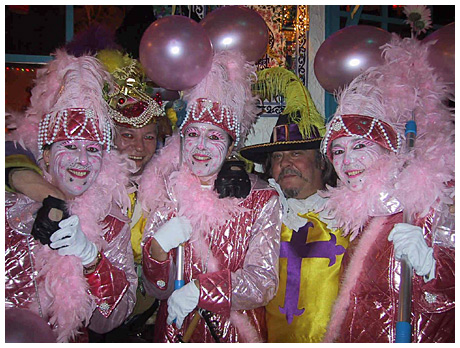
What makes Maastricht´s carnival special is its street carnival. During the 1960s and 70s carnival goers would hop from café to café, and from one carnival hall to the other. However thanks to the music bands, called “Zaate Herremeniekes” (literally “drunken bands”), carnival has moved to the streets, gaining in spontaneity. A “drunken band is an undisciplined bunch of non-professional musicians, wearing strange clothes and with no band leader,” laughingly explains Marleen.
Leon Hensels has been a member of music band “Vreug Zaat” (“Early Drunk”) for the past 22 years. (Anecdotically, in Maastricht´s carnival language, we should actually say that Hensels has been a member for 2 times 11 years.) Contrarily to what one may think, Vreug Zaat has nothing to do with being “drunk early” but with the fact that the band looks a bit messy, disorganised, with everyone wearing different outfits and even playing different melodies. Another band in Maastricht is called “Zoonder draank, Geine klaank” which means “No drink, No sound”. Its philosophy: uncomplicated and unorganised! Everyone can join a drunken band and the songs they play are all related to Maastricht´s carnival. What Hensels likes most about his band is its spontaneous element. “During carnival it happens very often that people with a music instrument join a band without being members. This is why sometimes a band grows so big that the musicians at the back are no longer playing the same tune as those at the front. But this is the nicest part of it, it’s not organised!”
Obviously, the drunken bands do indulge in some drinking, but not as much as their names would suggest, because they need to stay sober in order to be able to play all day and night. “They’re not drunk from the alcohol, but from the music,” says Marleen wittily.
The carnival song is chosen mainly by the people of Maastricht, but everyone present at the contest on 4 November was actually allowed to vote for their favourite tune. Carnival songs need to fulfil some criteria: they have to be about Maastricht (for example about a local political issue), they should have a nice melody (some Tempeleers confess a special taste for waltz), and the lyrics should not be impolite or too difficult to memorise…
The name of this year’s carnival song is “Dao kump Maria” (“There comes Maria”) “Maria is simply a woman from Maastricht. The song describes how she celebrates carnival: all by herself, but having fun with all the people around her. Just as we’re telling you!” explains Marleen.
“About 63 bands will be playing the new chosen song… or at least will try to,” quips Hensels. The bands take part in the big parade and like to accompany the Prince. They play whatever they feel like to. Someone can start a melody and the rest will just follow. No special costume is required, because “otherwise the band would look too organized”. “It’s just about having fun, together, with people you’ve just met, and without any structure,” insists Hensels. Vreug Zaat counts 27 official members. Other bands like “Vreug en Neugter” (”Early and Sober”) have 37, “Blamaasj” (”Disgrace”) 50 and “Katerjach” (”Headache Chase”) 26.
Blamasj
Maastricht’s best kept secret
Although every carnival association has its own Prince, there is only one Prince for “Groot Maastricht”. “Any man born, raised and living in Maastricht, and perfectly fluent in the Maastricht dialect can become the Prince, but someone has to put his name forward, he cannot volunteer himself,” explains Geurtjens.
Anyone can submit a candidate for the prestigious title to the Tempeleers, who then start examining each candidate and eliminating the men whom they don’t think are suitable. “Not everyone is capable of becoming a Prince,” says Geurtjens. “The Prince must have the carnival spirit, speak the dialect, not be afraid of making speeches in public, be open and have an easy contact with people.”
The candidates who have passed the eliminatory phase are subsequently observed by “the three stars”, who are three secret members of the Tempeleers in charge of the election process. Not even all the Tempeleers know who exactly these three persons are! “Big brother is watching you,” jokes Hensels, making everyone laugh. “But without cameras!” notes Geurtjens. After observing how the potential Princes behave in public, the three stars finally make their choice, but until the day the name of the new Prince is revealed to the people, his identity becomes “the best kept secret of Maastricht”.
Mysterious proceedings
One Sunday night, about eight or nine weeks before the start of carnival, Leon Geurtjens’ phone rang and someone told him that something had happened in a shopping centre. As the vice-president of the shop owners association of the shopping centre, Geurtjens had to go to the police office. There a man dressed up in a long black coat and doning a big black hat asked him to step into a car. Geurtjens quickly understood what was going on: one or two years earlier a friend had been carnival Prince and he was aware of this particular procedure. He was asked to also wear a big black hat and to lie down in the car so no one would see him. Then he was brought to a secret place, where he met “the other 2 stars”, and the first thing they asked was “Would you like to be the carnival Prince of the city?” He remembers taking some time to think about it, because “becoming the Prince is accepting a big responsibility as well as a full agenda of activities”. After the “yes” word, he was handed a “nursing bottle” to mark the fact that a new Prince was born!
During the next four weeks, or in Leon Geurtjens’ words the “nursing phase”, the the new Prince receives an intensive training about his duties and the history of carnival, and is groomed to becoming a Prince in every detail. For instance the Prince must get used to being addressed as “Ziene Hoeglöstigheid” (Cheerful Highness) from the very first moment after he’s accepted the title. All of this must happen with the biggest secrecy because not even the Prince’s family must know about it. In Geurtjens’ case, only his wife knew. Even the tailor who made his suit never saw his face or heard his voice. This secrecy contributes to raise the carnival feeling.
“Who is he? Do I know him?”
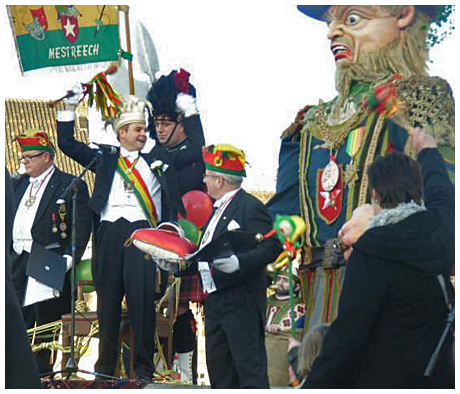
The new Prince is revealed to the people of Maastricht four weeks before the start of carnival. That day, the Prince is first taken to a secret place where he is given a glass of schnapps and some food and wine. Then, dressed up in a completely unrecognisable fashion, he is taken to Maastricht’s central train station where he joins a parade consisting of almost all Maastricht’s carnival associations and drunken bands. Upon arrival at the Market square, the new Prince’s identity is finally disclosed. “My heart is thumping at that moment,” says Marleen. “Who is he? Do I know him?”
Geurtjens’ eyes betray his emotion when he tries to describe what he felt. “The nicest part was the people’s enthusiasm. It is at this moment that you realise what the figure of the Prince means for the people,” he says, adding: “It was never me, but always us [the people of Maastricht]. We were doing carnival”. The most important duty of the Prince is to bring enthusiasm to the people, and the way he interacts with people is essential. Geurtjens found it amazing to receive congratulation letters from people he hardly knew: “I understood how deeply the carnival feeling is living in the people”.
A new ruler in town!
For the next four weeks Geurtjens, or Prince Leon II as he was then called, took part in about 280 activities. Every appointment had a different context for which a different speech was required. Prince Leon visited schools, the hospital (where he met with children suffering from leukemia), attended meetings at the provincial “gouvernement”, visited activities of other carnival associations, etc.

Every appointment was clearly planned in the “epistel” which is the very detailed agenda kept by the Tempeleers for every activity of the Prince. The appointments at his regular job had to be rescheduled until after the carnival season. In Geurtjens’ case, this was easy because he was self employed and did not have to ask for any permission. But in most cases companies will also show support if one of their employees becomes the Prince of Maastricht. “The company feels proud to have a Prince among its staff!” says Marleen.
“Being the Prince costs lots of energy,” says Geurtjens. For four weeks, the Prince is picked up at home everyday for an agenda full of appointments. But does the title also involve spending a lot of money? “Absolutely not”, says Geurtjens, “everyone can be a Prince.” The Prince is expected to pay for some of his clothing (namely his shoes and the suit he wears during the period between his proclamation and the Saturday before carnival). At the end of each day and after carnival the Prince also invites the Tempeleers for a drink. But if a Prince is not able to afford this, he will be supported by the Tempeleers, who can count on regular sponsors and contributors.
On the Saturday before carnival the mayor of Maastricht hands over the key of the city hall to the Prince and from that moment until the following Tuesday night at midnight the Prince “rules” over the city of Maastricht.
Marleen attended the carnival season’s closing ceremony at the Vrijthof square only once and promised herself never to repeat the experience. She found it “too emotional”. Her second promise: not to miss carnival again. Some 36 years ago, her father won a vacation to Austria and Marleen still regrets joining her family: after that “My whole calendar didn’t make sense anymore. Easter? I didn´t have carnival yet!”
Leon Hensels doesn’t enjoy carnival’s closing ceremony either. On this occasion as the “drunken” bands play the Maastricht hymn accompanied by a square full of people singing along, the Prince must return his “bonnet” (hat) and sceptre to the Tempeleers. He is driven back home - for the last time by his own chauffeur - changes his clothes, and continues celebrating carnival at home with friends and family but no longer as the Prince, just as himself. For Leon Geurtjens this was an emotional moment, but “I knew that there was a start and an end to this experience…. I enjoyed while it lasted and that’s what matters most.”
Do you have it?
“Carnival begins from the moment you start hearing carnival music and see people dressed up in the streets,” explains Leon Hensels. “Carnival is a feeling,” he stresses, “you don’t need to ask yourself “Must I find something to dress up or must I go out now?” It doesn’t work like this.”
“Not everyone needs to like carnival,” continues Hensels. “A Maastricht´s carnival song says “You have it or you don’t”, meaning that if you have [the carnival feeling] you don’t think, but just start celebrating. If you don’t have it, don’t force yourself. “If you don’t feel anything for this celebration, you can’t do anything about it,” says Leon Geurtjens. “Within the same family, one child can be crazy for carnival and the other one may feel nothing at all”.

I have enjoyed my chat with Marleen and the two former Princes and have learned a lot about the typical features of the Maastricht carnival: the whole secrecy around the Prince’s election, the excitement that goes with his proclamation, the idea of having fun with everyone, in an easy and spontaneous way… I feel that my opinion towards Maastricht’s carnival has changed, at least theoretically. What I want to do now is to experience it again in this new light.
By Diana Berdun
Diana Berdun is a Spanish expat in Maastricht. After completing her translation and interpreting studies in Spain, she came to Maastricht where she graduated in European Studies. Diana teaches Spanish at the Language Centre in Maastricht and at the Instituto Cervantes in Utrecht. “This is my fifth year here, but time flies and I have the feeling this is my place, for now”, she says.
Further information:
The Prince’s titles:
Every Prince is awarded a series of “titles”, linked for example to the part of Maastricht where he was born, the associations he belongs to, his profession, his hobbies, etc. Here is a sample of some of the titles received by Leon Geurtjens when he became Maastricht’s carnival Prince in 2003:
- Prinsenaom: Prins Leon d’n Twiede: the Prince’s name: Prince Leon the second.
- Deliciaticus Vonologicus Travellanicus: a reference to Prince Leon’s profession as the owner of a shop called Rommedoeke where one can by delicacies and good wine; by the way: Rommedoe is a smelly yet very tasty Limburg cheese.
- Erf-Prins vaan de Hierlekheid Potteberg: hereditary prince of Exquisite Potteberg; Pottenberg is a neighboorhood of Maastricht, where Prince Leon was born.
- Graof vaan Wolder tot Vroenhove: Earl of Wolder to Vroenhove; Wolder and Vroenhove are two neighborhoods of Maastricht; Prince Leon lives in Wolder.
- Honorair-Kletskesveger vaan de Wienacademie: a kletskesveger is someone who wipes the rests of food and/or drinks. Wienacademie is the Wine Academy so this title also refers to Prince Leon’s profession
- Groet-Sloeutelbewaorder vaan de Brusselsepoort: main keeper of the key of the Brusselsepoort shopping centre.
- Groet-Conservator vaan alle Kelderratte: Kelderratte was also a carnival association related to a school, probably the one Prince Leon attended at a child
- Drappo-Commandant vaan alle Zate Hermeniekes: Flag commander of all drunken bands; drappo is the flag, from the French word “drapeau”
- Protecteur vaan de Mestreechter Vastelaovend: Protector of the Maastricht carnival; this title is naturally given to every Prince!
Video clips:
This is a humourous film featuring Maastricht’s mayor Gert Leers, who is about to hand over the key of Maastricht to the new carnival Prince. Unfortunately the key is stolen by a mysterious thief…
If you understand Dutch, here is a four-part Dutch documentary of Maastricht’s “Carnival Feeling”. The site also offers many amateur video clips of the Maastricht carnival.
Carnival 2008 agenda
(source: The Tempeleers website)
Sunday January 6, 2008
Proclamation of the Prince of Carnival 2008 on the market square at 3.11 pm.
Friday February 1, 2008
Carnival at all schools in Maastricht.
Saturday February 2, 2008
1.11 p.m. Arrival of Prince of Carnival at the Central Railway Station.
Parade between Railway Station and the City Hall at 1.55 pm.
3.00 p.m. Reception at the City Hall where some ministers from the Central Government of the Netherlands, the Provincial Commissioner of the Queen and the Mayor of Maastricht are present. (invitation only).
7.33 p.m. Reception at the City Theatre
Sunday February 3, 2008
10.33 a.m. Ceremony at the “Palace” (home) of the Prince.
12.11 p.m. Official Opening of Carnival with eleven gunshots on the “Vrijthof”
1.44 p.m. Big parade in the city center.
After the parade Carnival in all streets and all pubs of the city center, up to 03.00 a.m.
Monday February 4, 2008
Parade of the children and families in the city center. During and after the parade, Carnival in all streets, squares and pubs, up to 03.00 a.m. next.
Tuesday February 5, 2008
2.11 p.m. Contest for all bands, brass-bands, etc. (up to about 5.00 p.m.)
3.11 p.m. Costume contest for children in “Festi-Village”.
During and after these events, Carnival in all streets, (see Sunday and Monday)
11.55 p.m. “Official” end of Carnival, but pubs remain open up to 02.00 a.m.
Related articles on Crossroads:


Excelente trabajo, enhorabuena.
Hee wat leuk Marleen om jou hier te zien en ‘te lezen’… Goed uitgelegd voor alle mensen die nog nooit van carnaval gehoord hebben. Veel plezier morgen oppe Vriethof!
groete vaan Olga
Hey pecadora muy bueno !.
Ahora sólo falta escaparme un año de estos para allá y probar.
Besos desde Canarias !!!!
Juanjo
Goot gedoon Marleen. Gooje tèks, leuke fotookes, leuke filmkes. Dee wat dit lees moot tog al de karneval-kriebelkes kriege.
Nederlands : goed gedaan Marleen. Goede tekst, leuke foto’s, leuke fimpjes. Degene die de leest moet toch al de carnaval-kriebels krijgen.
Have much fun during Carnival in Maastricht.
Yvonne Nix-Sins (zus van Marleen)
Un artículo muy detallado y divulgador, se nota que está muy trabajado y transmite las ganas de ir a vivir el carnaval a esa ciudad.
¡Felicidades Diana!
Amelia
De steis d’r sjoen op, Marleen! Iech kreig noe ech zin d’rin. En ouch leuk öm mien femilie en bekinde te zien bij Z.H. Blamaasj (met twie a-kes by the way).
And for everyone else who is reading this: ‘Vastelaovend in Meestreech’ (carnival) is the one thing you should have experienced at least once!
Ik had niet gedacht dat het zó’n uitgebreid artikel zou worden, maar het is heel erg leuk!! Zelf heb ik ook weer dingen gelezen die ik nog niet wist. En de carnavalskriebels beginnen langzaam maar zeker weer op te borrelen… Bij de link naar de amateur-videoclips zag ik één filmpje over “samba mestreech” erbij staan en dat is Passatempo! Hartstikke leuk!
Marleen, geweldig dat jij hier bij bent betrokken. Is jou op het lijf geschreven! Ik had je wel eens willen zien!
Keep up the good work!
groetjes
Vivi
¡ PEDAZO DE TRABAJO !!! Diana, ofreces una información increible, digna del mejor de los trabajos.
ENHORABUENA!! Y MUCHOS BESOTES.
Mariangeles.
me ha parecido estupendo el nuevo artículo. sigue por ese camino y llegarás a periodista de postín. Con varios idiomas. las ilustraciones me gustan mucho.
…it is a feeling indeed! and I am looking forward to it. As an international student in Maastricht, who just put some crazy clothes on and go out, it is already a good experience. Doing it again and understading the special meaning of the Maastricht Carnival, will be even better.
Congratulations for the good work.
Ana M.
Un catarro desgraciado
me tuvo en el dique seco
por eso no he comentado
el articulo tercero.
Ahora me pongo a leerlo
y digo, que largo es !
esto me seca el cerebro,
y ademas está en ingles !
Despues de cuatro semanas
de lectura diligente,
lo terminé esta mañana
a las doce menos veinte.
Ha merecido la pena
el quedarme sin neuronas.
No fué el esfuerzo baldio
para eso soy tu tio.
Ahora el catarro pasado
afirmo , reafirmo y digo
que aunque hable del carnaval
el articulo es muy serio
y no me parece mal,
que aunque no sea del Canario,
el articulo es muy…. BUENO!
Felicidades.
Dear Marleen,
Dank u well!
This article made me emotional and took me back to good old days in Maastricht…
Enjoy the Carnival!
Kind regards
Love from up-north!
Ik vond het geweldig dat ik Leon $Mary vond op mijn Computer Als een oude Maastrichtenaar dat mijn neef en nicht zig nog goed beezig hou den met Carnevalik Zou het wat leuk gevonden als ik dit nog eens kon mee maken een Tyd die voor mij niet meer weg geleg is Met Hartelijke Groeten en Nog veel Plezier Mijn Family in canadaPeter Cathe Hensels